Written by Jeremy Souffir Founder, JTS Tech Services

If you've ever tried to get a straight answer from a corporate chatbot, you already know the failure mode. The bot confidently misunderstands your question, offers three links to documentation you already read, and ends every dead-end response with 'Is there anything else I can help you with?' It's the customer support equivalent of being put on hold forever, but with the additional insult of an upbeat tone.
This is what happens when AI is deployed as a cost-cutting measure rather than a customer experience investment. The technology itself has gotten good enough to do better — the gap between what most businesses deploy and what's actually possible has never been wider. Here's what useful AI customer support actually looks like, and what it takes to build it.
The problem with generic chatbots
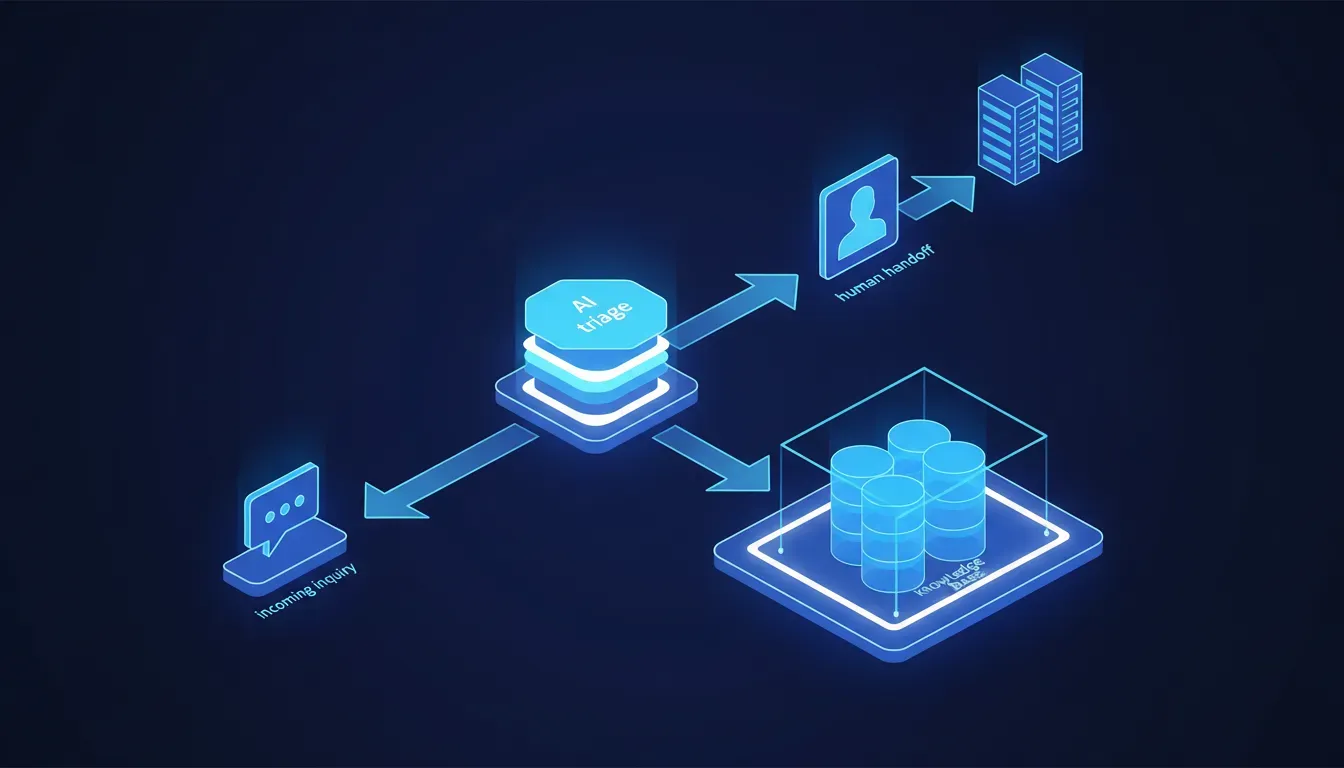
The cheapest AI support tools are essentially wrappers around a general-purpose language model with a FAQ document attached. They're fast to deploy and they handle a narrow band of obvious questions reasonably well. But they fall apart the moment a customer asks something slightly off-script — and customers always ask things off-script. Real support queries are specific, contextual, and often emotionally charged. A generic bot handles none of that gracefully.
The other problem is integration. A bot that can't look up an order status, check inventory, or access account-specific information is a lookup table dressed up as a conversation. It can only tell customers what they could have found themselves on your FAQ page. For anything with real utility — tracking a shipment, understanding why an invoice looks wrong, figuring out if a product works with their setup — it hits a wall.
- Generic bots lack access to the live data that makes support actually useful
- They handle common questions but fail on the long tail, which is where frustration lives
- Escalation paths are often broken — customers get stuck rather than routed to a human
- No memory of past interactions means repeating context every time
What actually makes an AI agent useful
Useful AI support agents have a few things in common. They're connected to live systems — order management, CRM, inventory, billing — so they can answer specific questions about specific accounts. They have a clearly defined scope: they know what they can do and what they can't, and they hand off gracefully when a request falls outside that scope. And they're trained on your actual support data, not just a generic FAQ.
The 'hand off gracefully' part is underrated. A good AI agent doesn't try to handle everything — it handles what it's genuinely good at and routes everything else to a human who has full context from the AI conversation. The agent becomes a triage layer that saves your support team from repetitive work while making sure complex or sensitive issues get human attention. That's a different value proposition from 'replace your support team entirely,' and it's a much more realistic one.
An AI agent that knows its limits and hands off well is worth ten times more than one that tries to handle everything and fails half the time.
Building for your specific context
The implementation work is where most businesses underinvest. Connecting to your systems requires proper API integration — not a demo that works with sample data, but a real connection to your live Shopify store, your CRM, your booking system. The data needs to be structured in a way the agent can reason about. The agent needs to be tested against the full range of queries your customers actually send, including the weird ones.
Prompt engineering matters more than most people expect. The instructions you give an AI agent — how it should handle ambiguity, what tone to use, when to escalate, what it should never do — directly shape every interaction. These aren't settings you configure once and forget. They need iteration based on real conversation data. The first version you deploy is never the best version.
- Connect to live order, account, and inventory data — static FAQs are a floor, not a ceiling
- Define clear escalation rules: what triggers a handoff to a human, and with what context
- Test against your actual historical support tickets, not idealized scenarios
- Build a feedback loop: flag conversations for human review and use them to improve the agent
- Start narrow — one category of support, done well — before expanding scope
What to measure
Containment rate — the percentage of conversations resolved without human escalation — is the headline metric, but it can be gamed. A bot that ends conversations by timing out rather than resolving them looks great on containment and terrible on customer satisfaction. Track resolution quality alongside quantity: did the customer get what they needed, and how long did it take?
The metric that matters most for long-term value is repeat contact rate. If customers are coming back with the same question because the first answer didn't actually solve the problem, you have a quality issue that no amount of containment rate optimization will fix. A well-built AI agent should reduce repeat contacts over time as it learns from its own failure patterns.