Written by Jeremy Souffir Founder, JTS Tech Services

Headless commerce has been the buzzword du jour in e-commerce for the last few years. Agencies pitch it. Platform vendors market against it. Blog posts describe it as either the inevitable future of retail or a massively over-engineered solution to problems most stores do not have. The truth is somewhere more useful than either position.
The concept is straightforward: separate the storefront (the head) from the commerce backend (the body). The backend handles products, inventory, pricing, orders, and fulfilment. The frontend is a custom application — usually built in React or Next.js — that fetches data from the backend via API and renders whatever experience you want. No theme engine limitations. No template constraints. Full control over the frontend layer.
What headless actually unlocks
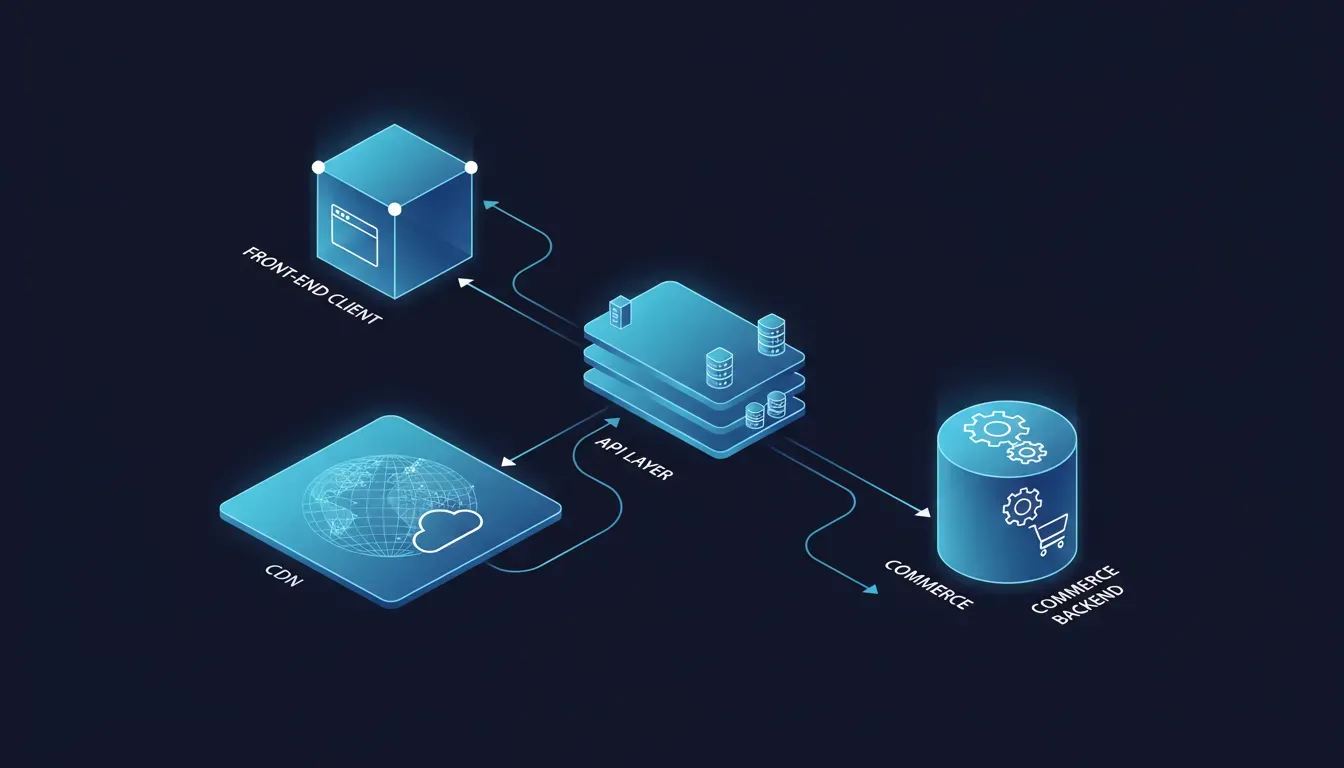
The most compelling headless use case is performance. A custom Next.js storefront, properly built with static generation and edge delivery, is noticeably faster than a traditional Shopify or WooCommerce theme. Page load speed has a direct relationship with conversion rate, and for high-traffic stores the performance difference pays for the development cost.
- Full control over frontend performance — no theme bloat, no unoptimised platform JavaScript
- Omnichannel: the same commerce backend powers your web store, mobile app, kiosk, and any other surface
- Rich, custom shopping experiences that a theme engine cannot produce — interactive configurators, editorial commerce, complex filtering
- The ability to use best-in-class tools for each layer independently
- A frontend codebase your development team owns and can deploy on their own schedule
Another real benefit is the decoupling itself. When your frontend and backend are separate applications, you can deploy a new storefront design without touching your commerce data. You can migrate commerce backends without rebuilding your frontend. You reduce the blast radius of changes on either side.
When headless creates more problems than it solves
Headless is not free. You are trading a solved problem (Shopify's theme system handles the storefront) for a custom engineering problem (you now own the entire frontend application, its deployment, its CDN configuration, its performance monitoring, and its ongoing maintenance). For many stores, that is not a good trade.
- You are a small store with straightforward needs — a polished Shopify theme is faster and cheaper
- Your team does not have the frontend engineering capacity to maintain a custom React application
- You rely heavily on Shopify apps that inject into the theme — many do not work with headless
- Your launch timeline is short and a headless build would take three times as long
- Your conversion funnel is already performing well and page speed is not the constraint
Headless commerce gives you everything and costs you the safety net. Make sure you want that trade.
The middle ground: composable commerce
There is a useful middle path that does not get enough attention. You can take a headless approach selectively — building a custom experience for specific high-value pages (the homepage, a product configurator, a landing page campaign) while keeping the standard Shopify checkout and standard theme pages for the rest. Shopify calls this their Headless SDK approach. It is not fully headless, but it gives you custom experiences where they matter without rebuilding the entire storefront.
The honest answer is that headless commerce is right for a specific type of client: established stores with meaningful traffic, a real performance problem, a need for custom experiences, and the engineering resources to support a custom frontend. For everyone else, a well-built Shopify or WooCommerce store with a quality theme is the faster, cheaper, and often better answer.
How to decide for your store
Start with the problem, not the architecture. If your store is slow and speed is hurting conversion, benchmark your current performance and model what the improvement would be worth. If you need to sell across multiple channels with a single inventory source, headless might be the right tool. If you want a custom editorial homepage but otherwise have standard e-commerce needs, a hybrid approach probably gets you there without the full commitment.
Architecture should follow business requirements. Choosing headless because it sounds modern is how companies end up with expensive, fragile storefronts that underperform the themes they replaced.