Written by Jeremy Souffir Founder, JTS Tech Services

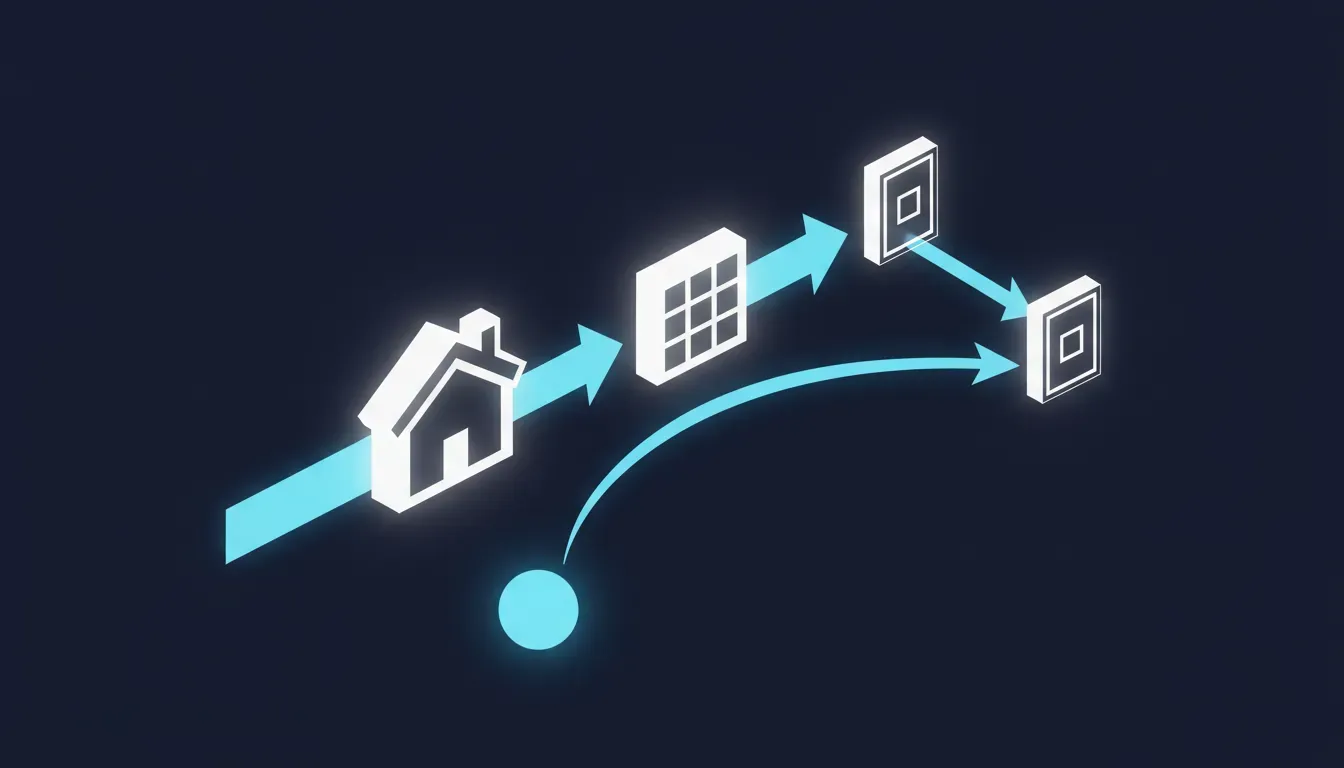
The short version: the entrance to your store has moved, and almost nobody has rebuilt for it. On its Q2 2026 earnings call on 5 August, Shopify said AI-driven traffic and orders both tripled year over year, that new-buyer orders arriving through AI channels came in at nearly twice the rate of other channels — and, the detail worth sitting with, that roughly half of AI-referred sessions went straight to a product detail page, about 2.5 times the rate of traditional search sessions. Your homepage, your collection pages, your carefully sequenced navigation: an agent-referred shopper skips all of it and arrives on one product, cold. Most stores are still built on the assumption that people walk in the front and browse inward. That assumption is now wrong for half the fastest-growing traffic source you have.
What actually changed here?
Nothing about your catalogue. What changed is the shape of the visit. In classic search and paid traffic, a session is a funnel: land somewhere broad, narrow down, compare, buy. The page you land on is a step, and it does its job by handing you to the next step. AI-referred sessions don't have that shape. The comparison, the narrowing and most of the deciding already happened inside the assistant. By the time a person clicks through, they are not starting a journey — they are checking one specific answer.
- The agent has already read your product data, alongside your competitors', and formed a recommendation before the shopper ever sees your site
- The click is a verification step: is this real, is it in stock, does it ship here, is the price what I was told, can I trust these people
- Everything you normally use to build that trust — homepage social proof, brand story, category merchandising, the nav — is behind them, not in front of them
- If the product page can't finish the job on its own, there is no second step to fall back on. They return to the assistant, not to your collection page
The honest read on these numbers
These are one platform's self-reported figures from one quarter's earnings call, and Shopify has an obvious interest in agentic commerce looking healthy. Treat the exact percentages as directional rather than gospel. It's worth knowing that independent analysts are more measured about AI shopping generally — Forrester's read this spring was that consumer adoption of buying inside the chat window stayed low, and that shoppers who clicked through to a merchant's own site converted far better than those asked to check out in the assistant. Those two pictures don't contradict each other, and they point the same way: the click-through onto your product page is the part that carries the revenue. Which makes it the part that had better stand on its own.
Why does that break how most product pages are built?
Because most product pages are written for someone who is already convinced they're in the right shop. They lean on context the visitor picked up two clicks ago. When that context never happened, the gaps are brutal and specific.
- Shipping, delivery windows and duties live on a policy page in the footer — a cold lander won't go looking, they'll just leave
- Returns terms are the single most common reason a first-time buyer abandons, and they're usually one click away rather than on the page
- Sizing, fit, compatibility and materials sit in a tab nobody opens, or in an image the agent couldn't read
- Reviews and trust signals are concentrated on the homepage, where this visitor never went
- Stock and lead time are implied rather than stated, so the one thing they came to verify isn't verifiable
- There's no lateral path — no variants, alternatives or 'people also considered' — so a near-miss product is a lost session instead of a save
The mistake we see most
Reporting AI traffic inside the aggregated 'organic' or 'referral' bucket. It disappears into an average, so the entrance behaviour is invisible: a product page that converts respectably as step three of a funnel can be quietly bleeding cold landers, and nothing in a blended report will ever tell you. The store then concludes AI referrals 'don't convert well for us' — when what's actually happening is that a page built as a step is being asked to work as a front door.
What about the long tail?
This is the part of the same disclosure that got the least attention and may matter most to smaller brands. Shopify said roughly three-quarters of AI-attributable orders in the quarter came from outside its hundred largest categories, and its president framed AI-powered search as having been particularly helpful to the smaller brands in the long tail of commerce. That is a meaningfully different competitive shape from ten years of SEO.
Classic search rewards category authority: the big domain wins the broad head term and everything under it. An assistant answering a genuinely specific request — a particular material, a particular constraint, a particular use case — isn't ranking domains. It's matching attributes. If your product is the actual right answer and your data says so precisely enough for that to be legible, being small stops being the disadvantage it was. The corollary is uncomfortable but fair: vague, generic product data is now a competitive choice, and specificity is the moat.

Does the source of the product data matter?
Considerably, on the same evidence. Shopify reported that AI search powered by its structured catalogue converted at roughly twice the rate of AI search that relied on scraped product data. The mechanism is unglamorous and entirely believable: a structured feed hands over complete, current, unambiguous attributes, while scraping produces a partial and sometimes stale picture assembled from rendered HTML. An assistant working from the thin version has to hedge, and hedged recommendations convert worse.
Practically, that means being readable is not the same as being represented. A store can be perfectly crawlable and still be described to shoppers from a guess. Getting into the structured channels — the platform catalogue, a clean feed, the agentic surfaces your platform exposes — is doing different work from writing better copy, and it is the work with the multiplier attached.
What should we actually do this month?
- Split AI- and agent-referred sessions into their own segment in analytics — Shopify surfaced AI-channel reporting in the admin this summer, and most stores still haven't turned to it
- Judge product pages as landing pages: entrance rate, entrance bounce, entrance conversion. Not their blended in-funnel numbers
- Rank your product pages by AI-referred entrances and fix the top twenty first. This is a small, finite list, not a re-platforming project
- Put shipping, returns, stock and lead time on the page itself, in text, above the point where a cold visitor gives up
- Move a real trust signal onto every product page — reviews, guarantee, who you are — because the homepage version is not being seen
- Add lateral paths: variants, close alternatives, and one honest route back into the catalogue for the near-miss
- Push the attributes that make each product specifically right — materials, dimensions, compatibility, use case — into structured data and your platform's catalogue, not just prose
- Re-check that your feed matches your site. Price and stock contradictions are the fastest way to be dropped from a recommendation
The encouraging part
Unlike most AI-visibility work, this is finished-in-weeks work with a clean before-and-after. You are not rebuilding a store or re-writing every SKU. You are taking a defined set of high-entrance product pages and making each one able to stand alone — and because you can segment the traffic, you get to watch entrance conversion move on exactly those pages. It is also work that pays off for every other cold-landing source you have: paid social, marketplace referrals, email deep links. Nothing here is wasted if the AI numbers plateau tomorrow.
Where we fit
The reason this one is worth handing to us rather than absorbing internally is that it sits across two teams that rarely talk. The page-as-front-door problem is merchandising and UX work; the structured-catalogue problem is data and integration work; and the measurement problem is analytics work that has to be set up before either of the other two can be proven. Split across a content agency and a dev shop, each assumes the other owns the middle, and the quarter goes by. Retaining us for AI Shopping Visibility means one team runs the whole loop — we measure what AI-referred visitors currently do on your store, fix the pages they actually land on, get your attributes into the structured channels properly, and then show you the same numbers again. Our audit is the cheap way to find out whether this is a real problem for your store before you commit anything to it.
Sources
- Shopify — Q2 2026 financial results (5 August 2026; the quarter's headline figures. The AI traffic, order and landing-page detail was disclosed on the accompanying earnings call rather than in the release)
- PYMNTS — Shopify's AI traffic triples as shoppers skip the search bar (earnings-call coverage: the tripling, the near-2× new-buyer rate, and roughly half of AI-referred sessions landing on product pages at ~2.5× the traditional-search rate)
- Digital Commerce 360 — How Shopify is approaching agentic AI so far in 2026 (the long-tail share of AI-attributable orders, the catalogue-vs-scraped conversion gap, and Finkelstein on smaller brands)
- Modern Retail — Shopify launches tools to help merchants track sales and traffic from AI platforms (the AI-channel reporting now in the Shopify admin)
- Shopify — The agentic commerce platform: connecting any merchant to every AI conversation (Catalog, agentic storefronts and the AI channels Shopify now supports)
- Forrester — Agentic payments in B2C commerce: where we are now (April 2026; the independent and more measured counterweight — low adoption of in-chat checkout, and markedly better conversion when shoppers are sent through to the merchant's own site)