Written by Jeremy Souffir Founder, JTS Tech Services

The short version: if your Merchant Center organic clicks and impressions fell yesterday, the most likely explanation is that nothing happened to your store. On 24 August Google changed the definitions behind those reports. YouTube affiliate traffic — the clicks that come from creators featuring products they earn commission on — has been pulled out of "Organic" and given its own interaction type, and the definitions for organic YouTube clicks and impressions have been realigned to match YouTube's own reporting standards. Google says plainly that this can produce a one-time significant drop in reported organic traffic. In the same release, product-level reporting for Google Ads widened to take in all ads channels and formats, including every network in Performance Max plus Video, App and Demand Gen campaigns, which can produce a one-time increase in ads impressions and clicks. Read those two sentences together and you can see the shape of the week: in one report, on one day, the organic line goes down and the paid line goes up, and neither movement is a result. It is an accounting change.
What actually changed on 24 August?
Google posted the notice on 11 August and it took effect yesterday. Four things moved, and they are worth separating because only two of them are retroactive:
- YouTube affiliate traffic is now its own thing. Clicks on products that are eligible for creator commission are reported under a new "YouTube affiliate" traffic value instead of being folded into "Organic". Products that are not commission-eligible stay where they were. Google's stated reason is to give a clearer view of standard free-listing performance, which is fair — but it means the organic number you were reading last month included something it no longer includes.
- Organic YouTube click and impression definitions were realigned to established YouTube reporting standards, for consistency across Google's surfaces. This is the change most likely to move your number on its own.
- Both of those are applied to historical data going back to 1 July 2026. Your past is not what it was on Sunday.
- Google Ads product-level reporting expanded to all ads channels and formats — all networks within Performance Max, plus Video, App and Demand Gen metrics. Google flags a possible one-time increase in impressions, clicks and related metrics. This one is not described as a retroactive restatement.
- A new "Network" segmentation dimension is coming later, so performance can be broken out by channel. Not live yet, and no date attached.
Where these specifics come from
All of the above is from Google's own Merchant Center Help documentation and the Merchant Center announcements changelog, not from a third-party read of it. We have linked both at the bottom so you can check the wording yourself, because the exact phrasing matters here: Google describes the organic movement as a one-time change and explicitly attaches the 1 July restatement to the two YouTube items. We have deliberately not put a percentage on the drop. Nobody outside Google can know how large it will be for your account, and it depends entirely on how much of your traffic was YouTube-sourced in the first place — which for a lot of merchants is close to none, in which case you will see very little. If you sell in categories creators cover heavily, you may see a lot.
Why does the retroactive half matter more than the drop?
Because a drop you can see is a question somebody asks. A restatement you cannot see is an answer somebody gives. If your organic line simply fell off a cliff on 24 August, the shape of the chart would at least prompt the right question. Instead the two YouTube changes reach backwards to 1 July, so the curve gets re-drawn smoothly and the cliff largely disappears. What you are left with is a summer that looks slightly worse than the one you actually had, with no visible event to explain it.
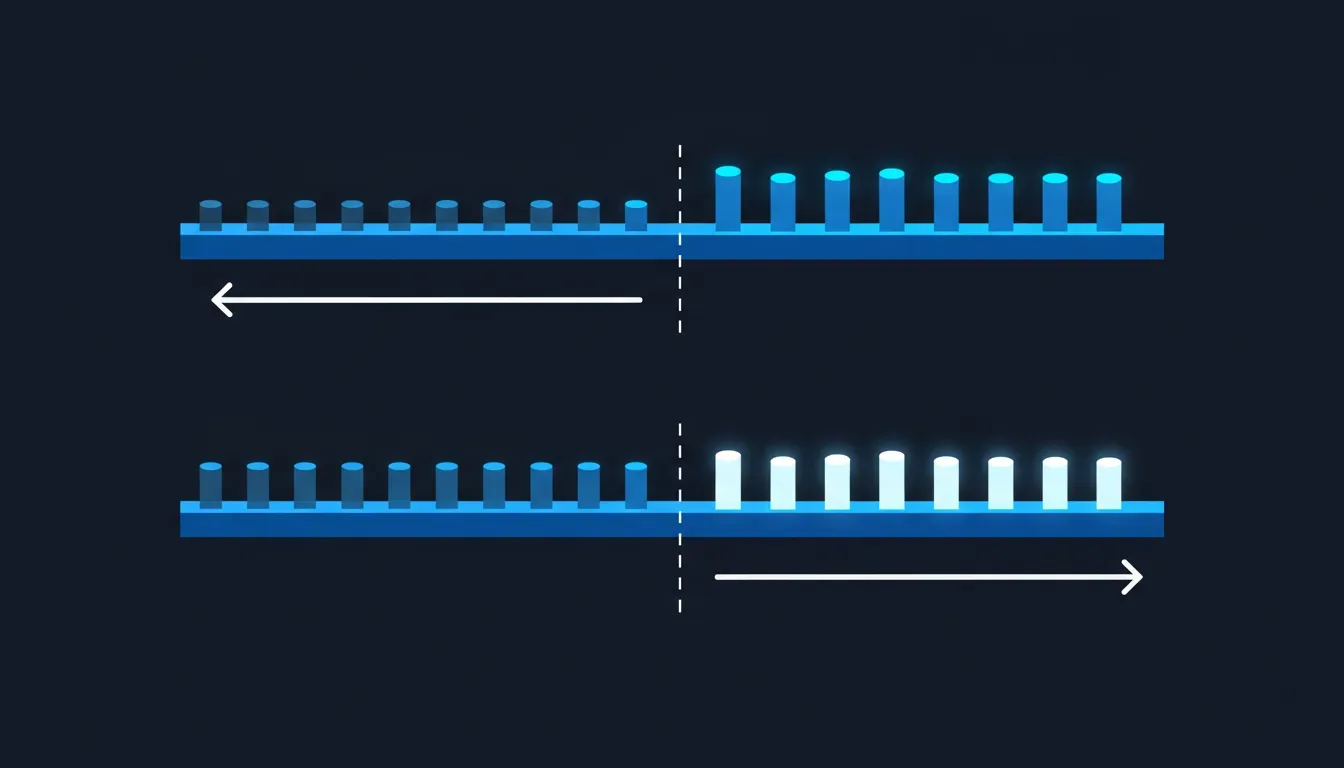
Then there is the asymmetry, which is the part we would put in front of a finance lead rather than a marketing manager. The organic restatement is retroactive to 1 July. The ads expansion is not. So for July and August your organic figures are computed under the new rules while your ads figures for the same weeks are a mix of old and new. Any paid-versus-organic comparison that spans this summer — a channel review, a budget case, an agency's quarterly deck — is now partly measuring a definitions change and presenting it as performance. It will not announce itself. It will just look like paid pulling ahead.
Is this Google tidying up, or building something?
Building something. The tell is the stated goal: aligning reporting definitions across Merchant Center, Google Ads and YouTube so the same word means the same thing everywhere. That is not the sort of work anyone does for elegance. It is the sort of work you do before you add a new surface to the report and need it to reconcile with everything already in there.
The surface being prepared for is not a secret. Google has separately documented AI performance insights for Merchant Center — the first native view of how your products show up in AI-powered shopping, with a share-of-voice metric measured against competitors you define, a breakdown of the shopping journey into discovery, evaluation and purchase, the product terms shoppers actually use, and a completeness score for your product attributes. Two caveats we will state rather than smooth over. First, Google's own help pages describe it slightly differently from each other: one limits the covered surfaces to AI Mode and AI Overviews and calls it a pilot with a limited number of US accounts, while another includes the Gemini app and describes a rollout across the US, Canada, Australia, India and New Zealand in the coming months. Treat the exact scope as unsettled. Second, the documentation is explicit that it only gives visibility for structured attributes and covers organic AI traffic, not ads. Which is a useful thing to know in advance: the report that is coming will grade you on the completeness of your structured product data, and on nothing else.

The two conclusions that both get this wrong
The first wrong conclusion is that organic is collapsing and the feed work should be cut. That reads a ruler change as a demand change, and it is the expensive mistake, because the structured product data being deprioritised is the exact input the AI surfaces are documented to read. The second wrong conclusion is the mirror image: it is only a reporting change, so ignore it. Also wrong, for an unglamorous reason — that number is wired into things. Quarterly targets, agency scorecards, blended-CAC models and in some companies somebody's bonus are all built on a metric whose definition moved on Monday. A change being an artefact does not stop it from driving decisions; it just stops anybody from arguing with it. Both readings make the same error: treating a measurement change as either a verdict or a non-event, when it is neither.
What would we actually do this week?
- Annotate the date before you need it. Put a note on 24 August in whatever tool your team actually opens — the analytics annotation, the reporting sheet, the board-deck footnote. The whole risk here is that in six weeks nobody remembers why the curve bends, and the person who does not remember will be the one presenting it.
- Check whether this even applies to you. If your products are not commission-eligible on YouTube and you get little YouTube-sourced traffic, the organic effect on your account may be negligible. Confirm that rather than assuming either way, because the answer determines whether the rest of this list is worth an afternoon.
- Do not rebase targets on the new organic number silently. If a target moves because the metric moved, say so in the same sentence you move it. A quiet rebase is how a definitions change becomes next year's baseline nobody can explain.
- Do not credit the ads increase to the ads. If paid impressions and clicks jump in the same week the report widened to take in more networks and campaign types, that is scope, not performance, and it will flatter a Performance Max review that has not earned it.
- Treat the YouTube affiliate split as new signal, not just lost volume. It is now a separate line for the first time. If creator-driven demand turns out to be a real share of your discovery, that is a channel finding you did not previously have.
- Get your structured attributes complete. Sizes, colours, materials, dimensions, weights — the boring fields. It is the work that pays under the current report, and it is explicitly the only thing the coming AI insights report can see.
The genuinely useful part
Underneath the inconvenience, this is Google doing something merchants have wanted for years: making free listings, creator traffic and paid ads mean the same thing in the same report, so the comparison between them is finally honest. Right now that costs you one awkward quarter and a restated summer. What it buys is a reporting layer where an AI-surface line can be added and actually reconcile with the rest — and where the score is a completeness score for your product data rather than a black box. That is an unusually fair contest. A mid-market brand that fills in its attributes properly can beat a much larger competitor that has not, because the measurable input is diligence rather than budget. It is rare to get told the exam syllabus in advance. Here, roughly, we have been.
Where we fit
We will be honest about the incentive here: the most likely casualty of this change is the kind of feed and product-data work we sell, because it is about to look like it stopped working in somebody's quarterly review. That is exactly why it is worth having someone who owns the number rather than the narrative. Retaining JTS on AI Shopping Visibility means the definitions change gets caught the week it happens instead of six weeks later in a board deck — we mark the break, separate what moved because of the ruler from what moved because of the market, and hand you a version of the summer you can actually defend. We then do the part the next report will grade: getting your structured attributes genuinely complete and consistent across the feed and the pages, so that when share of voice against your named competitors becomes a number on a screen, you are not discovering your dimensions and materials fields are half empty. And we keep telling you which of these announcements touches your business and which is noise, which is most of the value in a year where the measurement layer keeps moving under everyone.
Sources
- Google Merchant Center Help — Merchant Center performance reporting updates (the primary document: the YouTube affiliate split, the realignment of organic YouTube click and impression definitions, the 1 July 2026 historical restatement, the Google Ads product-level expansion across Performance Max networks plus Video, App and Demand Gen, and the forthcoming Network segmentation)
- Google Merchant Center Help — Merchant Center announcements change log (the 11 August notice and Google's own framing: to "improve clarity and provide a comprehensive view of your product impact" with greater consistency across Google surfaces)
- PPC Land — Google Merchant Center organic traffic drops in August 24 reporting change (independent coverage of the same notice, including the point that the retroactive restatement applies to the YouTube changes and not to the ads expansion)
- Google Merchant Center Help — About AI performance insights (share of voice against defined competitors, the discovery / evaluation / purchase breakdown, product term and attribute insights, and the explicit limits: structured attributes only, organic AI traffic only)
- Google Merchant Center Help — Insights for AI-powered shopping experiences coming soon (the attribute completeness score, and the wider surface and country list that differs from the page above)
- PPC Land — Google's new Merchant Center report tracks your brand in AI Mode (background on the AI insights report from its May 2026 announcement)
- JTS Tech Services — ChatGPT's ad business goes from 9 markets to about 40 (the other half of this problem: what happens when the organic surface has no dashboard at all to be restated)
- JTS Tech Services — Google built a cart that spans every store (why the product feed, not the website, is what these reports are ultimately grading)