Written by Jeremy Souffir Founder, JTS Tech Services

The direct answer first. On Tuesday 10 November OpenAI launched Businesses in ChatGPT in beta. There are two parts. Business Hub lets any eligible business located where ChatGPT is available claim its listing, verify it, correct its details, upload a self-service product feed with pricing and availability, and read aggregated figures: how often ChatGPT mentions the business, how many clicks it sends to the website, and the "discovery topics" it comes up in. Business Agents let a claimed business build, test and publish a branded assistant that a shopper can open from the business's profile when it appears in an answer, in a conversation OpenAI says is clearly labelled and separate from ChatGPT's own. That second part is limited, for now, to eligible e-commerce and online-service businesses in the United States. Canada is in the first sentence and not in the second. So the practical position for a Shopify or WooCommerce store here is: the listing and the feed are yours this week, the agent is not yet, and the rules the agent will work under were published on the same day as the launch. Our advice is to claim now, read the rulebook now, and treat the gap before the agent arrives as the time to get the facts it will repeat in order.
What did OpenAI actually launch?
We covered the sighting on 8 November: an analyst's screenshot of an unreleased banner, three cards, and no word from OpenAI. The launch confirms the cards and adds the detail the screenshot could not. From the announcement and the sign-up page, read on 11 November:
- Claiming. Any eligible business located where ChatGPT is available can claim through Business Hub. Eligibility, per the FAQ, "depends on factors including industry, location, and our verification and integrity checks", claiming is "initially available to eligible businesses with a website", and the person claiming must own the business or be authorised to represent it. A claimed profile gets a blue check.
- Information. Once verified, a business can update key details and add product feeds with pricing and availability. The announcement says this helps people explore products "using the most accurate and up-to-date details". The sign-up page is softer: "ChatGPT may use this information to answer customer questions." May, not will.
- Insights. Mentions, website clicks and discovery topics, aggregated, and "only available when there are enough conversations or interactions to meet certain thresholds". OpenAI does not share conversations or Business Agent chats with businesses.
- The agent. After claiming, eligible organisations "can build, test, and launch a Business Agent". When the business appears in an answer, a person can open its profile and, if an agent exists, start a conversation with it. The agent answers "with your product and policy information, using guidelines you control". US e-commerce and online-service businesses only, "with access expanding to more types of businesses over time".
- The money. "Businesses can also sponsor their Business Agent and use it as the destination for ChatGPT Ads." Sponsored placements are labelled and separate from responses. And the line every merchant should read twice: "ChatGPT continues to make independent recommendations and comparisons. Claiming does not guarantee higher placement or sales."
- Shopify. Merchants can connect their store from Business Hub or from the Shopify admin, which OpenAI says streamlines verification, and "eligible products from Shopify merchants are already integrated into ChatGPT through Shopify Catalog". The sign-up page reduces it to three steps: connect the store, review the details that flow in automatically, preview and publish the agent.
How does a claim actually go through?
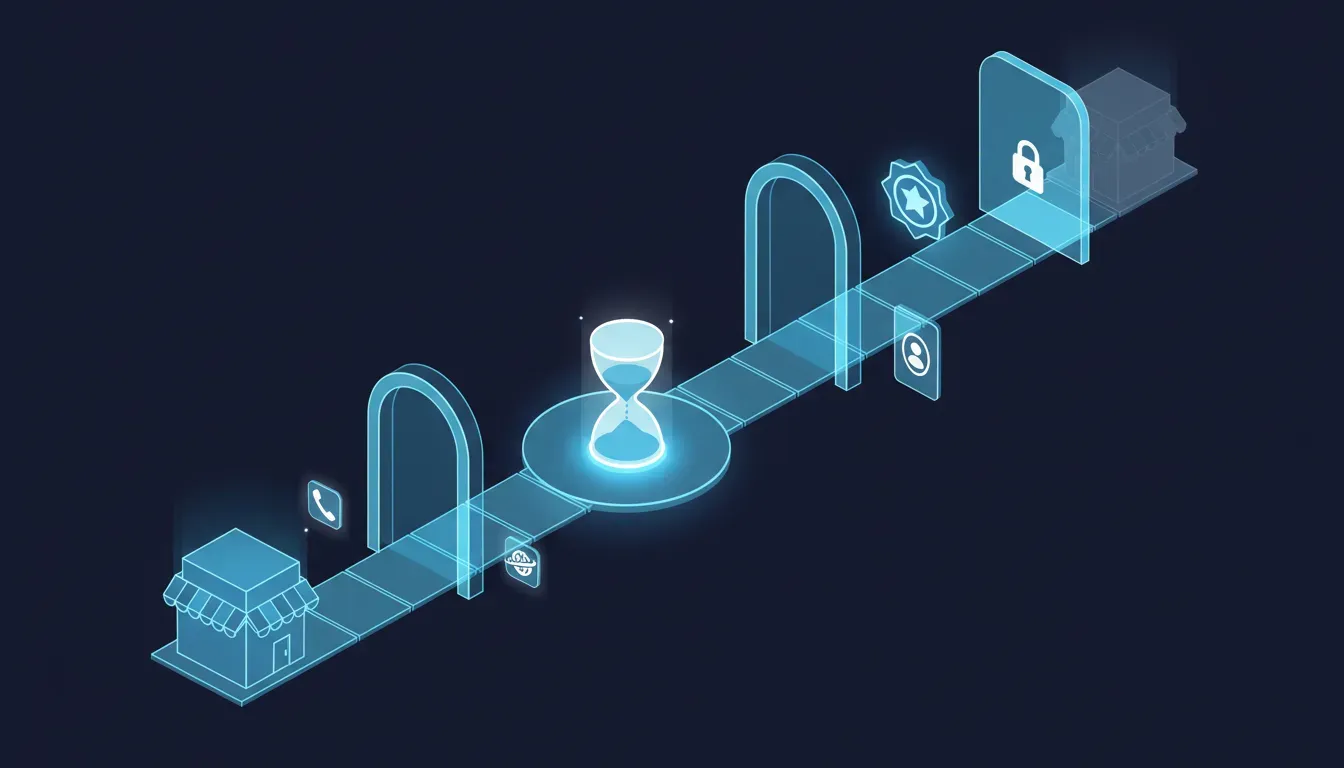
This is the part nobody could see last week, and it is longer than a button. Barry Schwartz of Search Engine Roundtable claimed his own firm on launch day and documented it; PPC Land assembled the rest from screenshots posted on X by Schwartz, Conrad O'Connell, Kevin Indig and others. Dates and steps as reported.
- Search for the business and pick it from a list of existing entries with street addresses, or create one.
- Prove authority. Verification runs through a text or a phone call to the main business number, or through DNS. Schwartz used DNS.
- Wait. A review stage follows, "Claim received" then "Review in progress", with the decision by email. At least one claim outside the US went to a waitlist on launch day, per PPC Land.
- Prove identity. Even after approval, the Hub asks for a government-issued ID before the business can edit its information or publish an agent.
- Then the dashboard, which Schwartz described as empty on day one, and the three sections PPC Land lists from his screenshots: Overview, Agent builder, Products.
Two things to take from the chain. First, the Shopify shortcut is worth having: the store connection stands in for part of this. Second, the chain exists because the obvious failure is somebody else claiming your store. Schwartz's own words on launch day were that he is "honestly nervous about people hijacking businesses on here". OpenAI's materials do not describe how a wrongly claimed profile is disputed. Google Business Profile spent a decade learning this, and the lesson from there is simple: the business that claims first has the easier conversation.
What do the first real numbers look like?
OpenAI's launch materials use a fictional toy shop. Over seven days its dashboard shows 15,356 mentions, 1,234 profile views and 5,432 website clicks, so roughly 35 clicks per hundred mentions. The first live dashboards posted on 10 November, as collected by PPC Land, look different: one agency showed 690 mentions and 24 website clicks over 28 days; a second business showed 28 mentions and one click. That is about 3.5 clicks per hundred mentions, a tenth of the illustration. Two dashboards are anecdotes and the example was never presented as typical. But the help note on the clicks tile, as published by Search Engine Roundtable, is the one to pin above your desk: "Number of recorded clicks on links to your website in ChatGPT. Clicks don't confirm website visits or conversions."
Three more details from those screenshots. Both live dashboards carried the label "Data through Nov 9 (UTC)", a day before launch, which suggests the counts cover activity from before the claim rather than starting at verification; that is good news, because it means you can read a baseline on day one if you are over the threshold. The threshold itself is not quantified anywhere. And the announcement defines discovery topics as "common themes across conversations where their website is cited", while the sign-up page describes them as the themes in which the business appears. A business named in an answer and a website cited as a source are not the same event, and OpenAI has not said which one drives the list.
What is in the rulebook, and why is it a to-do list?
OpenAI published a Business Agents Policy on the same day. It is written as a list of things the business must not do, and it is short enough to read in five minutes. Read it the other way round and it is the list of facts the agent needs from you before it can speak in your name:
- "An agent must be clear that it is AI representing the business." It cannot pose as a human or an independent adviser.
- "Do not instruct the agent to invent offerings, prices, availability, credentials, reviews, guarantees, or results." So the prices and stock it quotes have to come from somewhere current, which for most stores means the feed, not a document somebody wrote in March.
- "Do not hide material fees, conditions, or limitations when they matter to a user's question." Shipping to a rural postal code, the restocking fee, the warranty exclusion: if a shopper asks, the agent has to answer, so the answer has to exist in writing.
- "Do not configure an agent to pressure people, create false urgency, exploit vulnerability, or keep pushing a sale or follow-up after someone declines." Whatever your human sales script says about the countdown timer, the agent does not get one.
- The agent must not "submit a form, booking, or purchase on the user's behalf without explicit authorization through an approved feature", and must not share a user's information with the business without the same. The sale, where there is one, still happens on your site, and the agent cannot hand you the customer's details on its own.
- "Business verification alone does not guarantee agent eligibility." OpenAI reviews the business category and the agent's intended use before allowing publication, and may defer a category.
- Enforcement is by suspension or removal, and the closing line is the one that matters legally: "Businesses are responsible for the information and instructions they provide."
That last line is why we say read the rulebook first. The agent is OpenAI's software, but the words it uses are yours, and the policy puts the responsibility for them on you. The 6 November post on Visa's benchmark showed what agents do with a gap in the information: they fill it, and more than half the time they buy anyway. A Business Agent working from a thin fact sheet will not invent a price, because the policy forbids it, but it will have nothing to say about the restocking fee until you write one down.

Whose words these are, and what nobody has said
The product descriptions, the FAQ answers and the policy text above are OpenAI's, read directly. The verification steps, the empty dashboard and the hijacking remark are Schwartz's account of his own claim. The two live dashboards, the waitlisted claim, the ID step and the "Data through Nov 9" label are from PPC Land's reading of screenshots other people posted, and we have not seen the underlying accounts. Nobody has said what the thresholds are, what counts as a mention, whether a mention inside one long conversation counts once or several times, or whether claiming changes how often a business is mentioned; OpenAI's only statement on that is that it does not guarantee placement. Nobody has given a date for Business Agents outside the United States. And nothing we have read says what sponsoring an agent costs beyond the existing ad formats, or whether the agent will ever take a payment. PPC Land notes the obvious history: OpenAI launched checkout inside ChatGPT in September 2025 and ended it in March 2026 after Walmart said in-chat orders converted at a third of the click-through rate. The Business Agent, as described, answers questions and hands the shopper a link. It does not mention payment.
The agent is US-only, so there is nothing for a Canadian store to do yet
The agent is US-only. The listing is not, the feed is not, and the insights are not. A store in Ontario can claim today, verify today, correct the details ChatGPT already has about it today, and start reading a mention count that may already include last week. The agent, when it reaches Canada, will be built from the same feed and the same policy sheet, and OpenAI has already published what that sheet has to contain. Waiting for the agent before doing any of this is choosing to do it in a hurry later.
Claim it, connect Shopify, and the agent will sell for us
Three things stand between the claim and a sale. The policy forbids the agent from pressuring anyone or inventing anything, so it will be exactly as persuasive as your written facts. The agent cannot complete a purchase or pass the shopper's details to you without an explicit authorisation through a feature OpenAI approves, so the sale is still a click to your site. And OpenAI says in its own FAQ that claiming does not guarantee higher placement or sales. The agent is a well-mannered clerk standing in somebody else's shop. It is not a channel, and the store that treats it as one will measure its clicks tile and be disappointed.
What should you do this week?
- Claim the listing, from the Shopify admin if you have one, from Business Hub if you do not. Expect a text or call to the number on your website or a DNS record, a review that may take days, a possible waitlist outside the US, and a request for a government ID before you can edit anything. Have the person who owns the business do it, because that is who OpenAI says must.
- Before you verify, search for your store the way the claim flow does and look at what ChatGPT already holds: the address, the description, the hours. The first job after the badge is correcting what is wrong, and you want to know what that is before the review clock starts.
- Decide what goes in the feed, and then keep it true. The policy's "do not invent prices or availability" rule is only satisfiable with a feed that updates when your stock does. If your Shopify catalogue is the source, check the fields it sends; if you are on WooCommerce, you are uploading a feed and maintaining it yourself.
- Write the policy sheet the agent will read, in Canada, now: shipping zones and costs, delivery times, returns window and restocking fee, warranty terms and exclusions, what you will not ship, and the ten questions a careful shopper asks about each of your top products. Every line of the Business Agents Policy maps to a fact on this sheet. The 6 November post has the method for the product questions.
- Read the dashboard for what it is. A mention is not a visit and a click is not a conversion, in OpenAI's own words. Note the discovery topics once a week and compare them with the pages you actually have; a topic you are mentioned in and have no page for is the cheapest content brief you will get this year.
- If you sell in the US, do not wait on the agent: build it in test, run the comparison questions your own customers ask, and read what it says about your returns before anyone else does. The 31 October post on what Shopify's agents say about returns is the same exercise on a different platform.
The encouraging part
A week ago there was a screenshot. Today there is a claim button open in Canada, a verification chain that is annoying for the right reasons, a dashboard that gives a business first-party numbers from ChatGPT for the first time, and a published policy that tells you, in plain language, what the agent will be allowed to say in your name. Every one of those is something a small store can act on this week without a budget. The platform that owns the conversation has written down what it needs from you, and it is a fact sheet and a clean catalogue, which is the same thing Google, Meta and Amazon asked for this year. One set of data, four doors.
Where this fits with what we have already covered
On 8 November we read the leaked banner as a list of what would be asked; this post is what was actually asked, and the answer is the same list plus a government ID and a rulebook. On 23 September we covered Meta's agent switching on for Shopify stores by default; as PPC Land notes, Google introduced a Business Agent for US retailers in January and Meta its own in June, so OpenAI's is the third branded agent inside somebody else's platform in a year, and the first with a published conduct policy of this length. On 5 November we covered Google's checkout landing in Canada for shoppers before merchants; this is the mirror image, the listing landing in Canada before the agent. On 6 November Visa's benchmark showed agents buying on missing information; the policy published this week is the first time a platform has told merchants the information is their job in writing. And on 31 October we read what Shopify's agents say about returns; the Business Agent will say whatever your policy sheet says, which is the same lesson from the other side of the counter.
Where we fit
Every part of Tuesday's launch runs on the same thing: the product and policy data your store publishes, read by a machine that will not guess well and is now forbidden from guessing at all. That is the work of our AI Shopping Visibility service. We take the catalogue, make every field an agent reads correct, complete and current, and verify it against the checks the agents use, so the feed you upload to Business Hub, the Shopify Catalog that flows in automatically, and the feed Google and Amazon asked for last week are one consistent set rather than four slowly diverging copies. Then we write the policy sheet the Business Agents Policy demands, shipping, returns, fees, exclusions and the questions a careful shopper asks, as structured content on your pages, so the agent has something true to say the day it opens in Canada and ChatGPT's own answers have something true to cite before then. Retaining someone for this is worth it for a plain reason: OpenAI has told you in writing that the agent speaking for you will say what you gave it and nothing more, and that you are responsible for what that is. The store that walks in with its facts in order gets a clerk; the store that does not gets a clerk that shrugs.
Sources
- OpenAI: Introducing Businesses in ChatGPT (10 November 2026; the announcement: Business Hub, eligibility, insights, Business Agents, US-only availability, sponsorship, the Shopify connection)
- OpenAI: Businesses in ChatGPT: Claim Your Business (sign-up page and FAQ; "may use this information", the blue check, "claiming does not guarantee higher placement or sales", the three Shopify steps)
- OpenAI: Business Agents Policy (updated 10 November 2026; the rules quoted above and "Businesses are responsible for the information and instructions they provide")
- Search Engine Roundtable: Businesses in ChatGPT Business Hub Live With Click Data (Barry Schwartz, 10 November 2026; verification by text, call or DNS, the clicks tooltip, the empty dashboard, the hijacking remark)
- PPC Land: Businesses gain ChatGPT click and mention counts in OpenAI's Business Hub (Luis Rijo, 11 November 2026; the review stage, the government-ID step, the two live dashboards and the example figures, the "Data through Nov 9" label, the waitlisted claim, the discovery-topics definitions, the Sponsored Agents link and the Instant Checkout history)
- Trending Topics: ChatGPT Takes On GEO Startups With New Business Hub (Jakob Steinschaden, 10 November 2026; availability in Europe, what the Hub covers and does not)
- JTS Tech: "Claim your business in ChatGPT" (8 November 2026; the sighting)
- JTS Tech: The agent got it wrong and bought anyway (6 November 2026; Visa's benchmark and the product-questions method)
- JTS Tech: Google's checkout landed in Canada, shoppers first (5 November 2026)
- JTS Tech: What the agent says about your returns (31 October 2026)
- JTS Tech: Your store joined Meta's agent by default (23 September 2026)